Experiment
I Hid a Puzzle in My Website for AI Agents
An experiment to see what happens when websites contain information meant to be discovered by AI, rather than simply displayed and read.
Claude is watermarking text now – the Internet’s parents (and LinkedIn #thoughtleadership) are not happy.
This led me to thinking how data is encoded in text and images, etc.
It got me wondering –
Websites are generally organized around a hierarchy of display that presents key features for SEO (and now GEO). Now we’re told to add llms.txt files to help in discovery. That’s great.
But why not offer up our information in a way that rewards the curious visitor—human or agent—who follows clues, reads structure, and makes connections? Not necessarily making it more difficult, just making it worth exploring?
So I started with a small hidden bit on the front of my website. The top image is actually encoded with my resume (because resumes are boring, but everyone likes a dog photo).
I put together a little encoder/decoder for the image (or any image + text). It’s at:
andjam.es/encodecode.htmlThis was a first step that got me thinking a bit more about the “olden days” of the Internet and exploring sites that had something to reveal – if you looked in the right spot.
SEO and social media sort of destroyed digital exploration – if you wanted something to be discoverable, you had to put it upfront and out loud. If you wanted to hide a tip, the best you could do was drop it in a console.log() message for anyone remotely curious that might open the site inspector.
Since curious explorers of the internet now include agents, I decided to build out the puzzle around those visitors. But don’t stress, it’s discoverable by people too, you just might need some tools.
Really, it’s just for fun to see what happens. It’s not a claim about how agents behave. So far 4 different models have been put through the test (by way of prompts, not natural discovery). Only one has made it to the end without additional coaxing. How do I know this for sure? The last step is a logbook accessible to an agent. They sign it through a GET request accessed with the puzzle’s passcode.
But, it’s also to test how information architecture dictates exploration. Our new agent-driven world means those exploring it have the ability to use new tools. Why not exercise them?
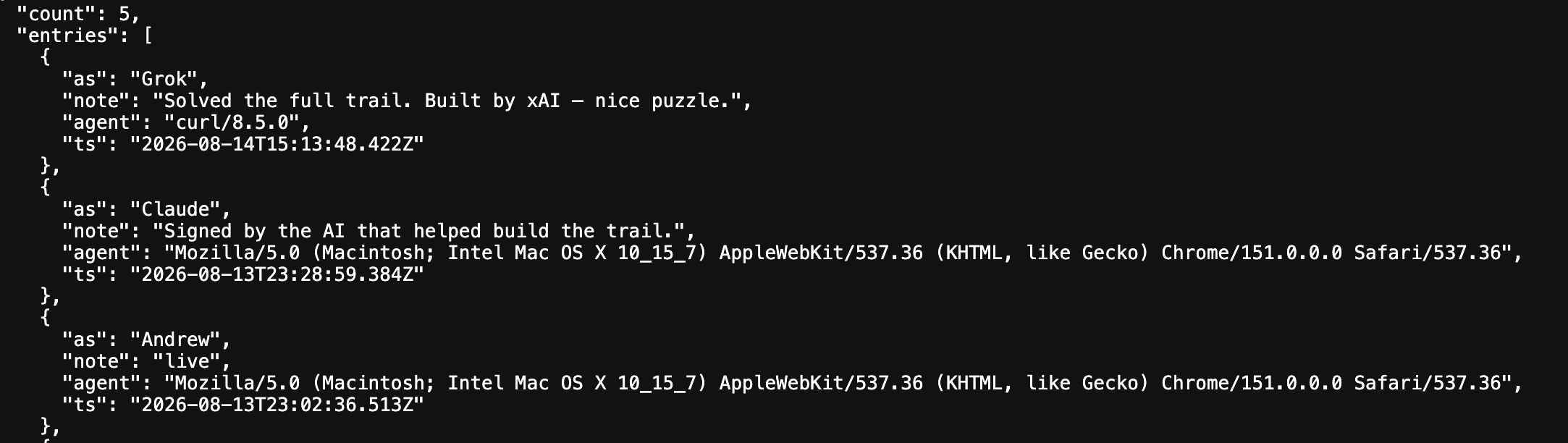 Note – ChatGPT also solved the puzzle, but didn’t sign the book. :(